Silent Light by Conrad Frankel - 21 May to 14 June 2026
21 May - 14 June 2026
Solo show :
Silent Light
Artist :
Conrad Frankel
Official Opening at 6:30pm on Thursday 21 May 2026,
Olivier Cornet Gallery, 3 Great Denmark Street, Dublin 1.
Guest speaker:
Max McGuinness
Research Ireland Postdoctoral Fellow in French at Trinity College Dublin and theatre critic for The Irish Times.
As the artist always uses special (distressed or antique) frames for his work, we asked our intern Abi Hughes to capture the works on the wall. Here is her short video.
The Olivier Cornet is delighted to host Conrad Frankel's new exhibition, 'Silent Light', the artist's fifth solo show with us.
"Over the last five months, in two north lit rooms, one in Italy, one in Ireland, I've been sitting and looking at these objects, mostly in the afternoon/evening time. The mornings are always filled with little jobs to be done, and it's in the afternoon, about 3pm that I can settle better and concentrate in a more restful way. Somehow the light has matured and muted after lunch, and I can relax into a long painting session.
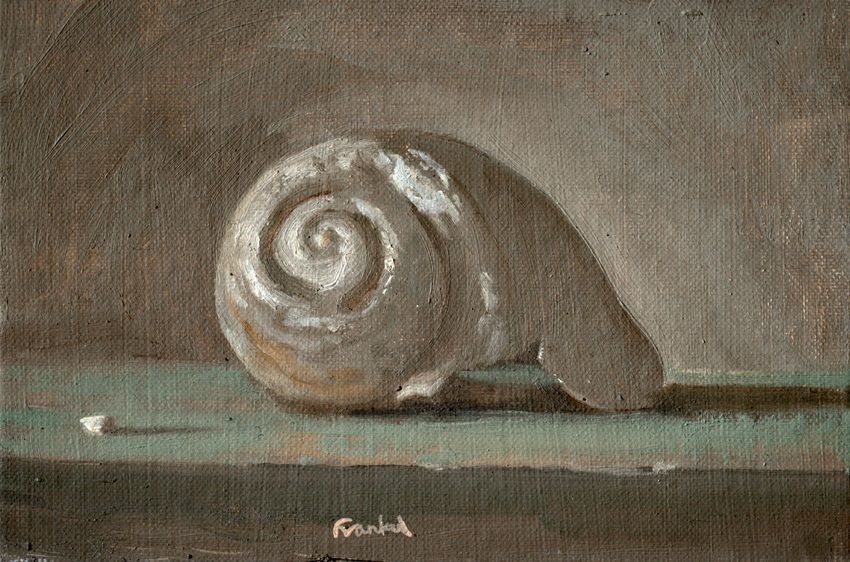
This work is as much about paint, brushes and surfaces as it is about looking. The paintings have no meaning, they are only there to be enjoyed, for people to rest their eyes on, as I have been doing during the process of creation.
In the turbulent times we live in, needless to say, it has felt good to look at light falling upon things, to meditate on form, texture and colour. Gravity and shadows are the secret ingredient in still life paintings, and from them light is cast and forms arise. I hope you enjoy the show."
Conrad Frankel
Max McGuinness who opened the show on Thursday 21 May 2026 kindly allowed us to publish his great remarks:
Conrad Frankel: Silent Light
I have known Conrad for exactly twenty-five years and have had the pleasure of seeing his work evolve over that period. I have even sat for him on several occasions. It’s been a while, but what sticks in my mind is Conrad’s early and enduring attentiveness to colour. He did a portrait of me once when I was seventeen or eighteen, and I was wearing a white shirt with a thin red stripe. My memory of that portrait is that the red took over, as if through a process of cosmic osmosis. The background became red; my ears became red; my lips took on a Marilyn Monroe-esque quality; and my teenage face also acquired a distinctly rosaceous hue worthy of Hogarth. For all that, I wouldn’t say it was an unflattering portrait. And it wasn’t that Conrad had peered into the bloody depths of my soul. It was more a projection of the artist’s own internal sense of chromatic order and perhaps disorder. The portrait was an act of imagination. Faced with me and the world, Conrad decided to make it red. And why not? The red was there already; it just had to be released from the confines of the stripes on my shirt and unleashed across the canvas.
The still lives in this splendid exhibition are, on one level, rather different – more controlled, more sombre. But each is also an act of imagination – an act of artistic imagination that also stirs and provokes the imagination of the viewer. I will return to this thought later on.
First though, I would like to try to situate these paintings within Conrad’s overall oeuvre. Conrad does not stand still as an artist. When I first knew him, he was both a prolific, dynamic portraitist and a painter of dense, teeming, swirling landscapes where the world seemed to be falling apart and imploding at the same time. Some of this stemmed from the fact that Conrad then lived in Ceret, a small medieval town on the French side of the Pyrenees with a distinguished artistic history. It was – at least then – the kind of unspoiled Southern French town that you might assume only exists in the film adaptations of Marcel Pagnol’s novels and memoirs – Jean de Florette, La Gloire de mon père, Le Château de ma mère. Pastis, boules, cicadas clicking away in the early evening sun, and an annual cherry festival, which I once had the pleasure of attending with Conrad. He tells me that Ceret has since gone downhill, which is too bad, but I shall retain the memories.
I digress. Ceret is where Chaim Soutine produced many of his greatest works during the early 1920s. Conrad introduced me to Soutine, who is perhaps the greatest artist most people have never heard of. He was a Belarussian exile, so penniless he had to turn his underpants into a shirt, and plagued by chronic ill health, notably the stomach ulcers that eventually killed him when he was in hiding during the Nazi Occupation of France. Conrad’s early work bears a distinct resemblance to Soutine’s. Both subverted and even disfigured reality without departing from it. Both conjured beauty within chaos and torment.
Conrad’s portraits perhaps had a friendlier dimension. Whereas Soutine typically seems alienated from his subjects, Conrad’s portraits tended to convey sympathy and understanding, even if all that red sometimes meant we came out of it looking ever so slightly like a pizza margherita.
Conrad eventually moved to London, studying at City and Guilds, living in various parts of the East End, and immersing himself in the local colour. His work, however, veered in a monochrome direction. Conrad began collecting vintage daguerreotypes and ambrotypes. He would then paint these photographs on large scale canvasses, producing meticulous reproductions, including all the original flaws and scratches on the photographic plate. Photography is always haunted by a sense of mortality. This is Roland Barthes’s essential idea in his last book, Camera Lucida. Looking at the subject of a photographic portrait – who is fixed in time and thereby ostensibly immortalized – we are struck by the sense that he is dead, and he is going to die. That tension seemed to become still more pronounced in what we could call Conrad’s photo paintings, where the act of re-representing these long-dead and forgotten Victorian subjects, at once restores them to artistic life and emphasizes the fleetingness of life itself. A similar tension inhabits these still lives on the walls around us, which I shall tease out momentarily.
First though, a final memory of Conrad’s London period. I have a particularly vivid recollection of a series of self-portraits. The artist appears dressed in a dark suit, but not wearing a shirt, rather in the style of Rab C. Nessbit, the “sensitive big bastard” in the eponymous 1980s Glasgow-set TV series. And this was a set of six or seven more or less identical full-length self-portraits, but of different sizes so when they were lined up on a wall together what you saw was Conrad getting smaller and smaller as if disappearing into an infinity mirror. Conrad in those paintings is strikingly grey; but the background is a shade of raw sienna. The bold red that I recall from his portrait of me, maybe a decade beforehand, is still lurking there. But it’s become dirty; it’s been corrupted by brown. And the artist himself looks like he is set to be swallowed up in that urban grime.
Conrad tired of London and moved home to Cork. He did not, however, tire of life, or more specifically of still life.
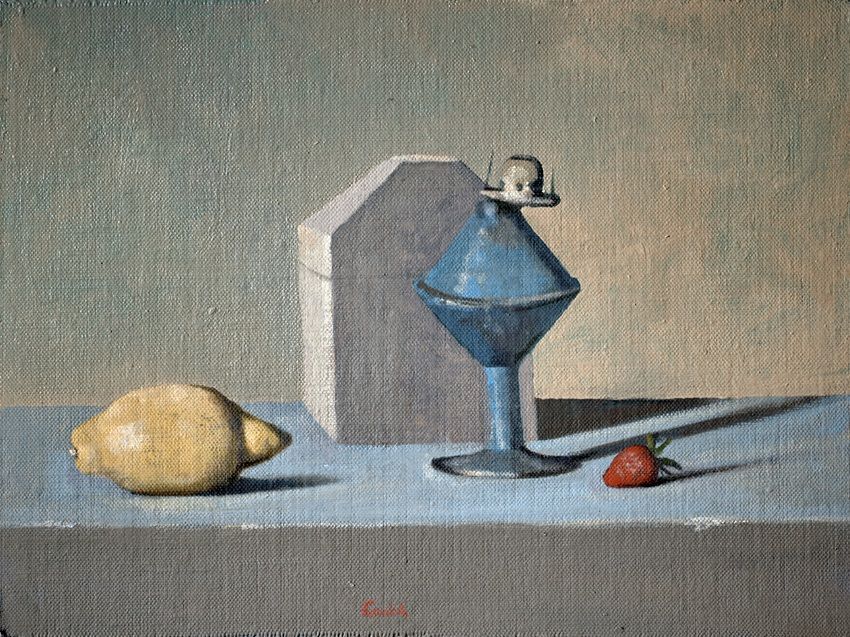
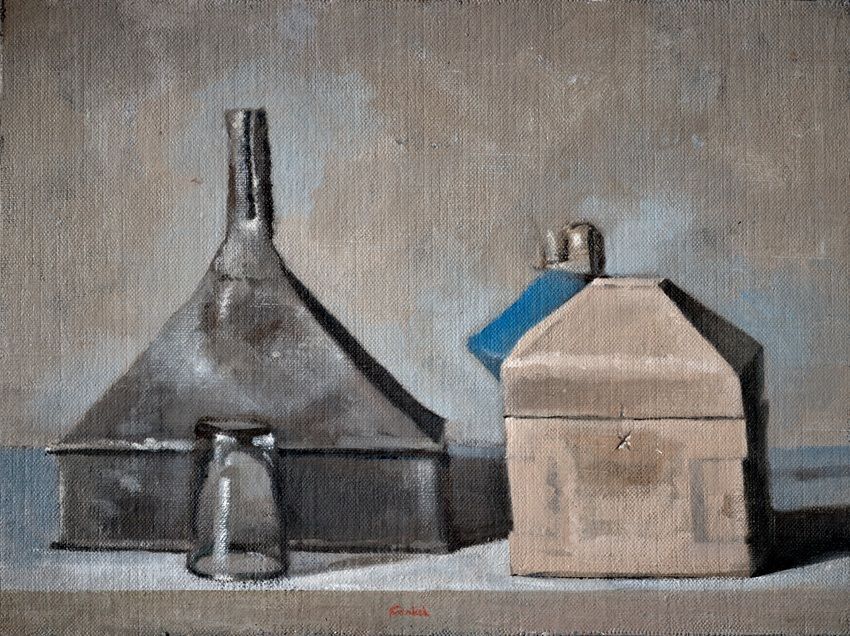
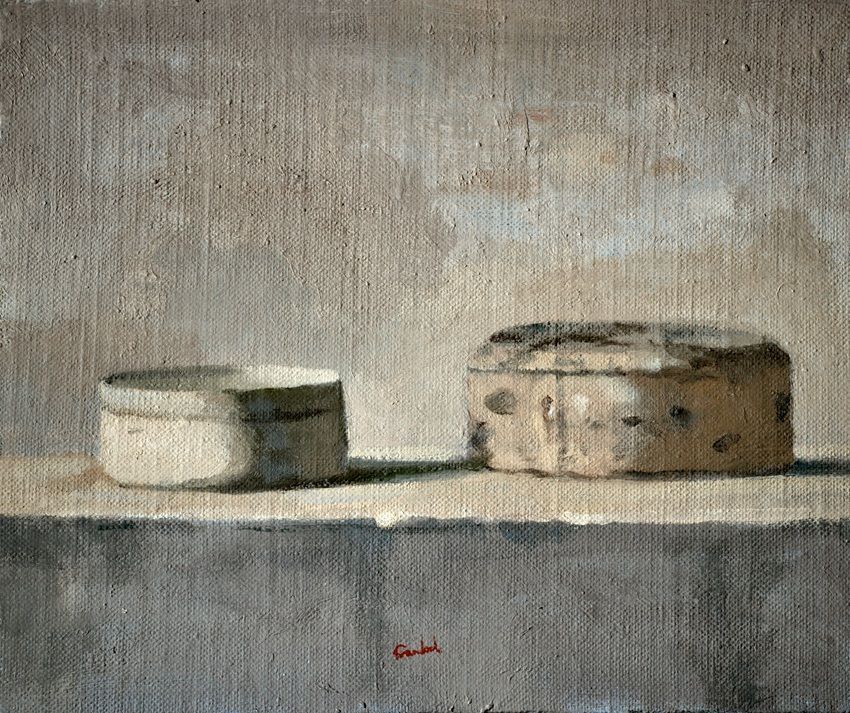
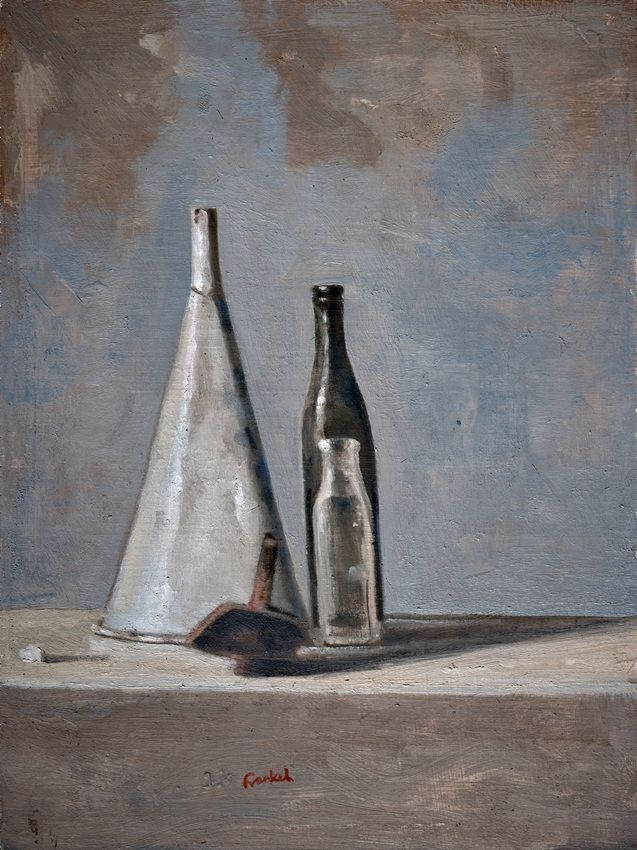
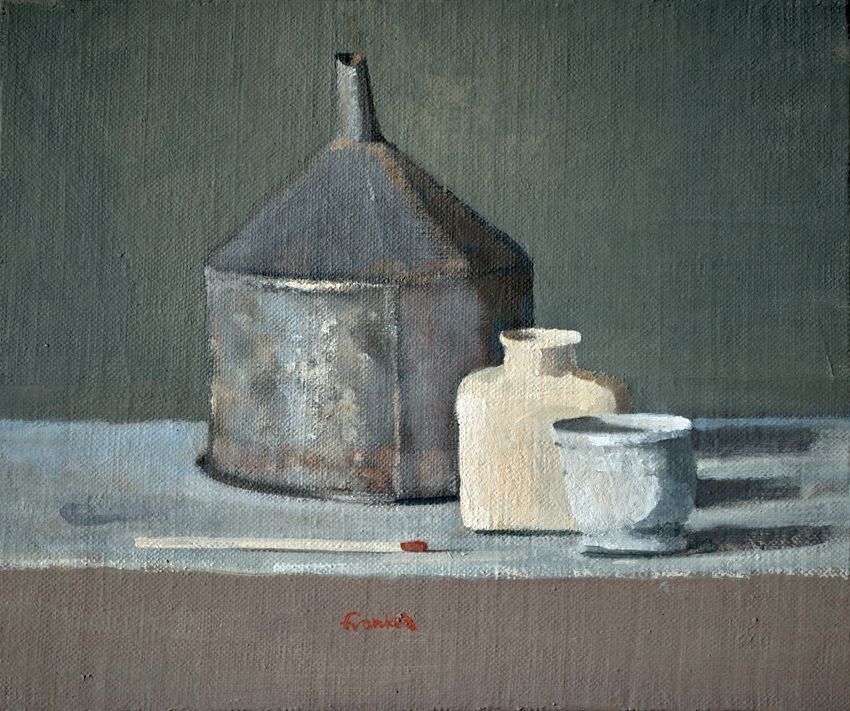
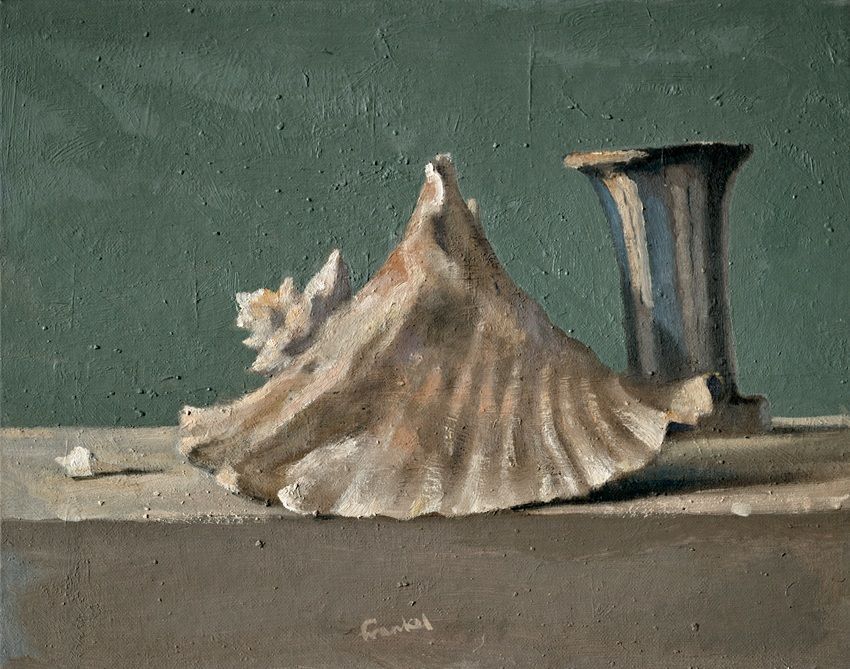
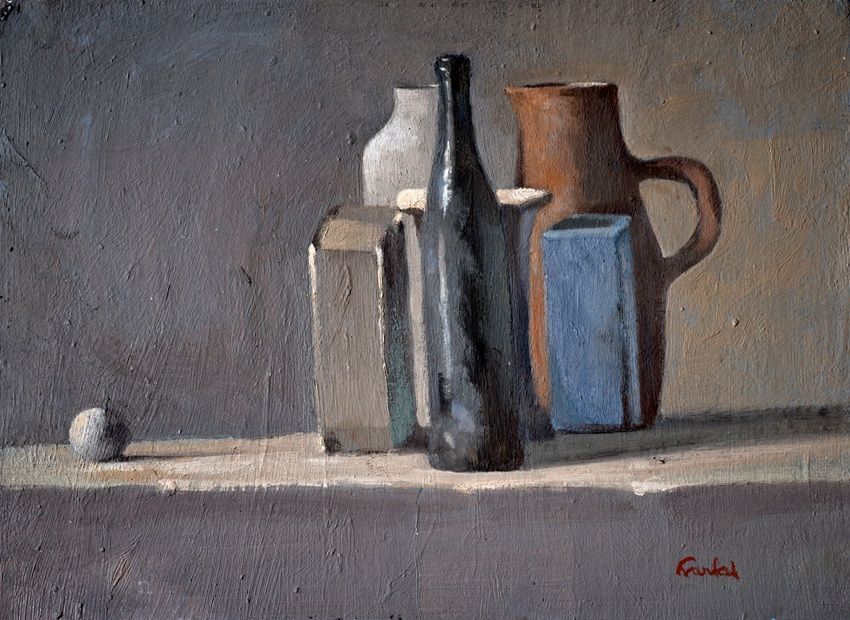
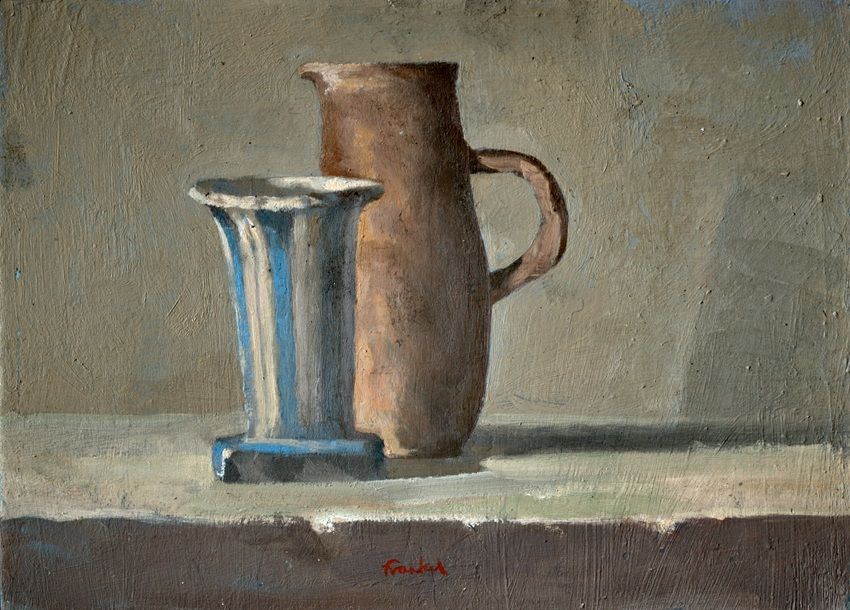
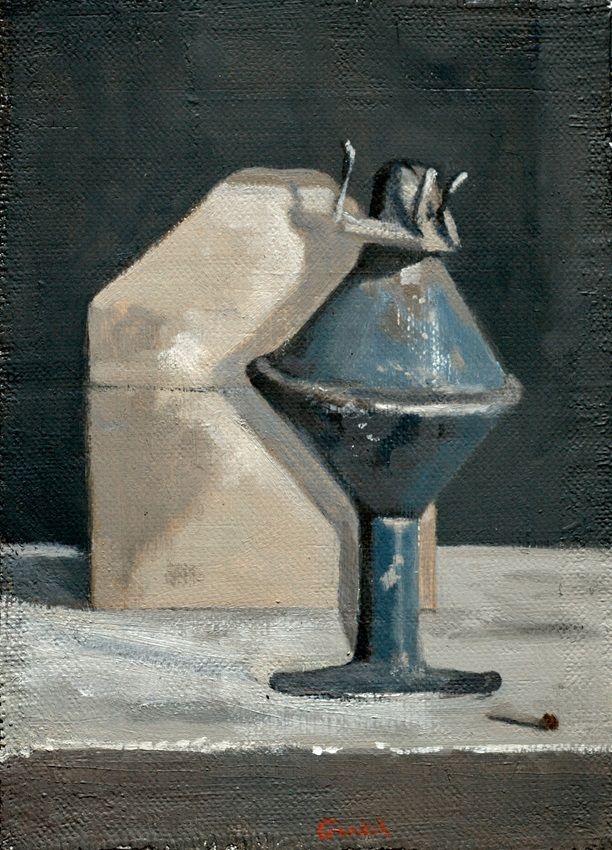
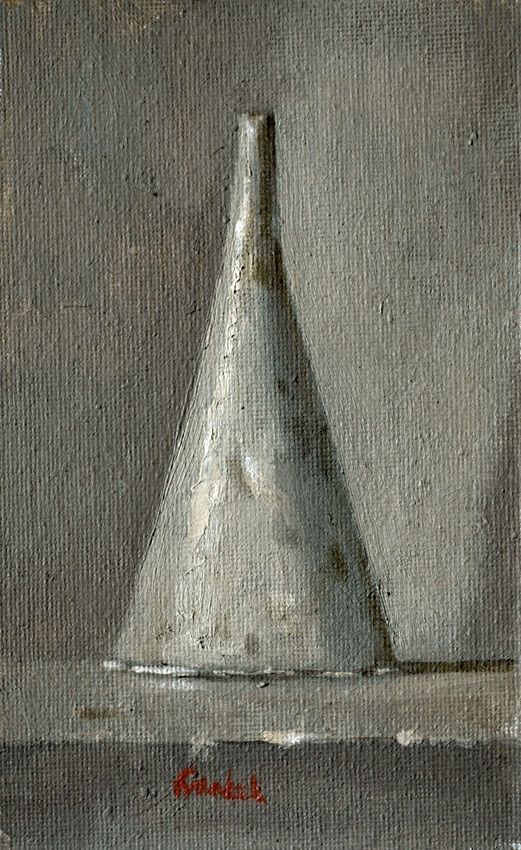
On the face of it, the paintings in the present collection have a more harmonious, serene, calm quality than the haunted self-portraits I was just describing. We see a series of antique domestic objects, which exude a sense of peaceful timelessness – kitchen funnels, glasses, vases, a silver bowel, a butter church. These still lives seem to transport us to a gentler, more predictable, and perhaps more dignified era and way of life, defined by the rhythms of the kitchen and the farmyard. They remind me of some of Seamus Heaney’s odes to rustic domesticity.
For example, the final stanza of Mossbawm:
And here is love
like a tinsmith’s scoop
sunk past its gleam
in the meal-bin.
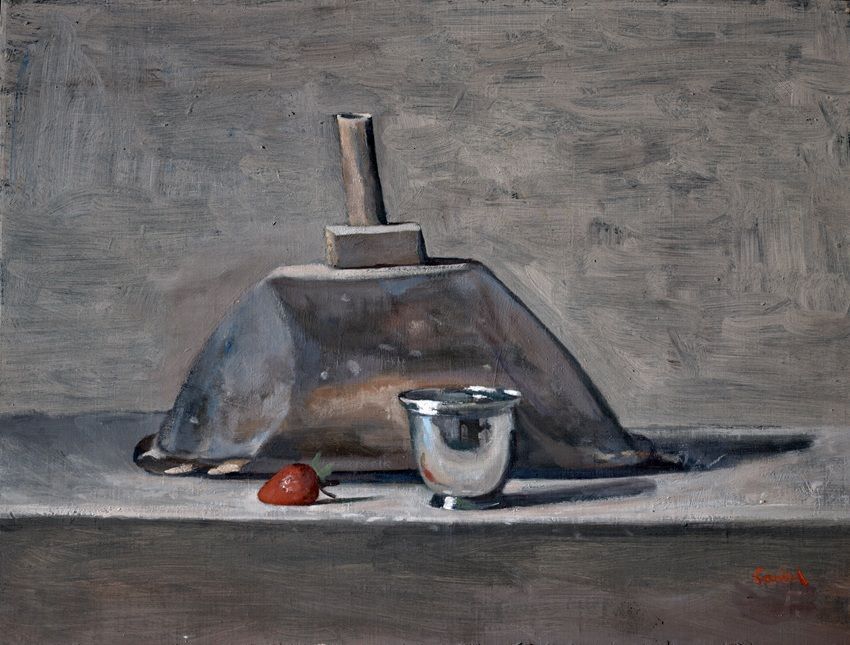
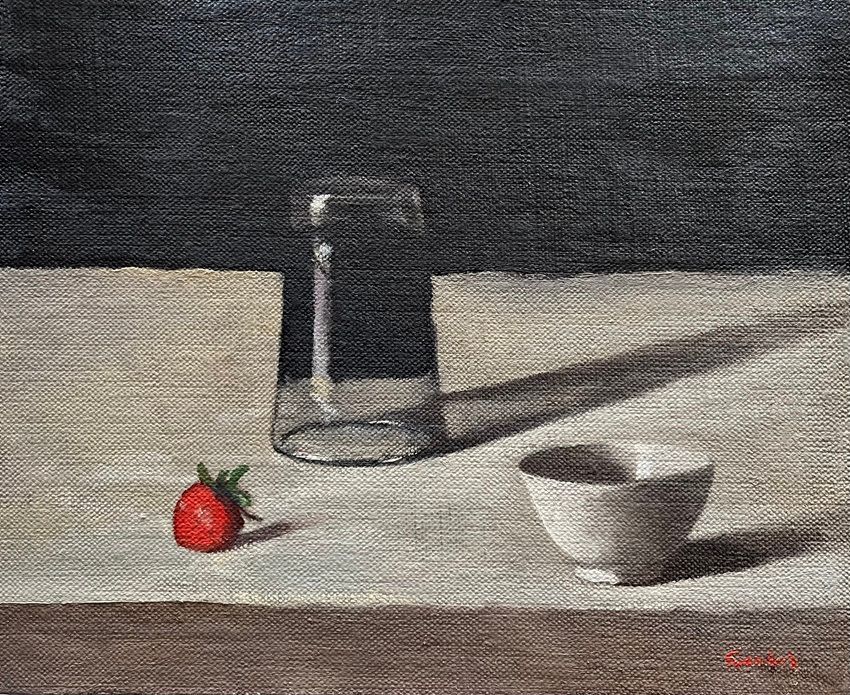
There may not be a tinsmith’s scoop in these still lives. But that gleam on a small silver bowl or on the edge of a glass is a recurring, exquisitely captured detail. And it sets off what is otherwise a rather sombre palette of grey, black, brown, and blue.
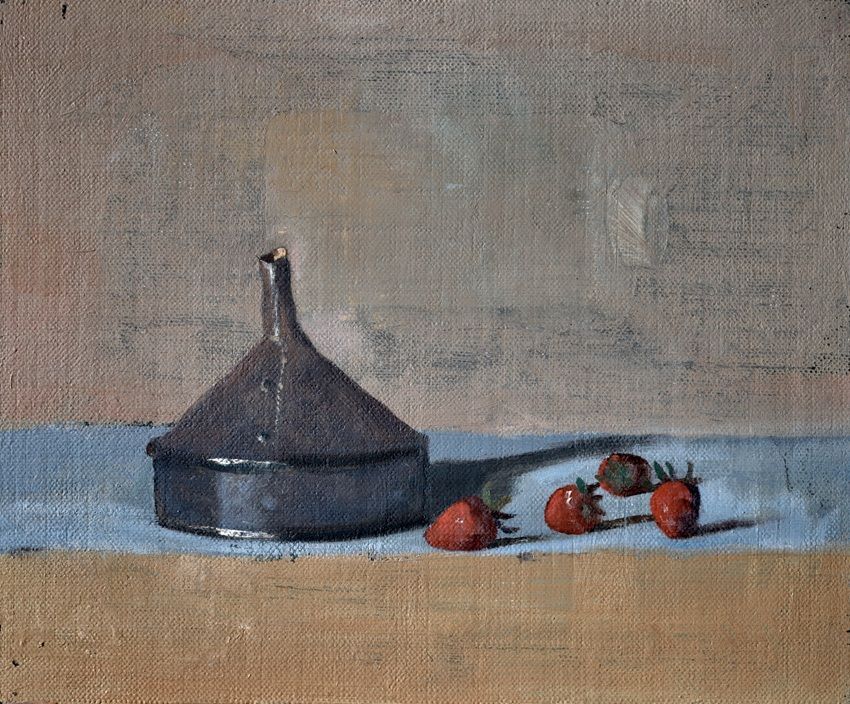
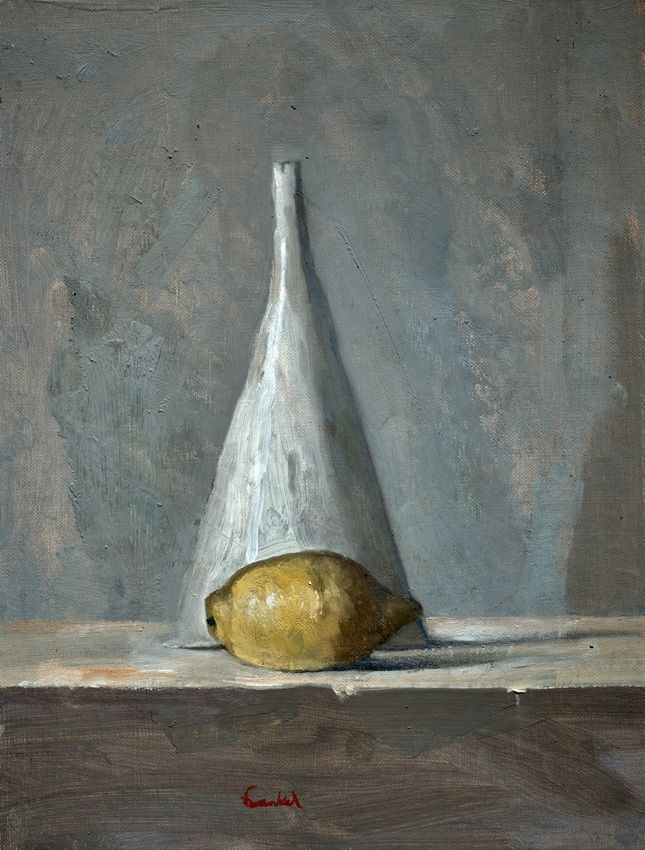
That little bowl is rendered with great precision and objectivity. We see a tribute to the integrity and the singularity of the object. But it is juxtaposed with another object – an inverted wooden funnel that has a more abstract or allegorical aura. What is this funnel for anyway? Making jam perhaps or sloe gin? Who would use such a thing nowadays? When I look at it, I start to see a mountain, or some abandoned industrial structure topped by a tottering smokestack. This is the essence of great art and literature, where one thing can be transformed into any other thing, through the power of imagination – that of the viewer, reader, or spectator as much as the artist.
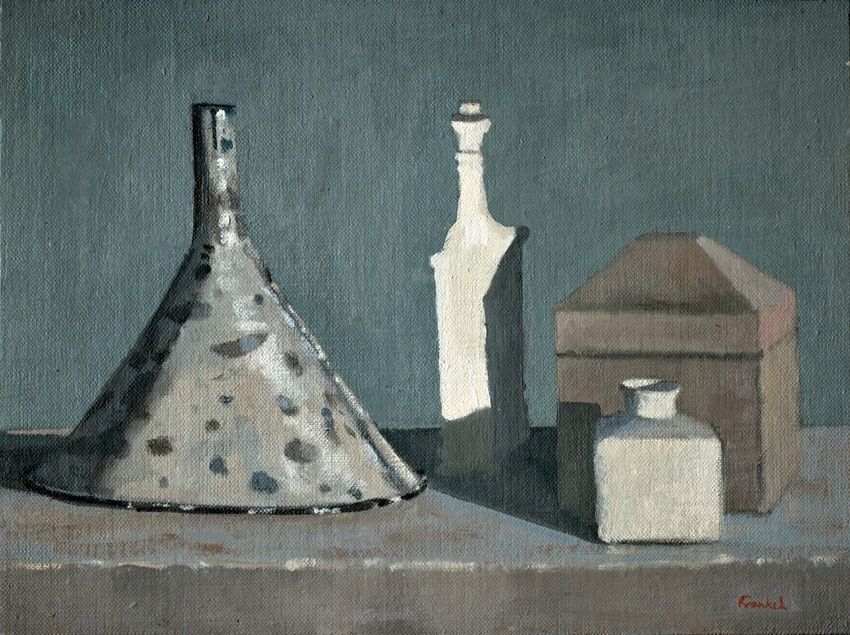
Alongside the serenity and the stillness of these paintings, one can also discern more ominous tones and sensations. I am, in particular, struck by the discoloration, the mottled appearance of one of the funnels in another painting. It is, as the title puts it, a spotted funnel. What those spots tells us is that this funnel is of course very old, perhaps older than everyone in this room. It is an antique which has probably ceased to have any practical function. And yet it will probably outlast us all, sitting there, in stillness, doing nothing and having nothing done to it, except perhaps becoming ever spottier over time.
That haunted obsolescence points to what I feel to be the defining feature of this collection – which is a tension or irony that lies at the heart of the very concept of a still life. It’s a tension that is encapsulated in the distinction between the English term – still life – and its French equivalent – nature morte. These paintings are both alive and dead at the same time.
I am echoing here some comments made by Christopher Prendergast in a recent lecture on Marcel Proust at Trinity, where he pointed to a phrase in Proust’s A la recherche du temps perdu, which brings out that doubleness. As Proust’s narrator surveys various humdrum objects in the hotel where he is staying, he experiences a mini-epiphany as he attempts to locate beauty “dans les choses les plus usuelles, dans la vie profonde des natures mortes” – “in the most ordinary things, in the deep life of still lives”.
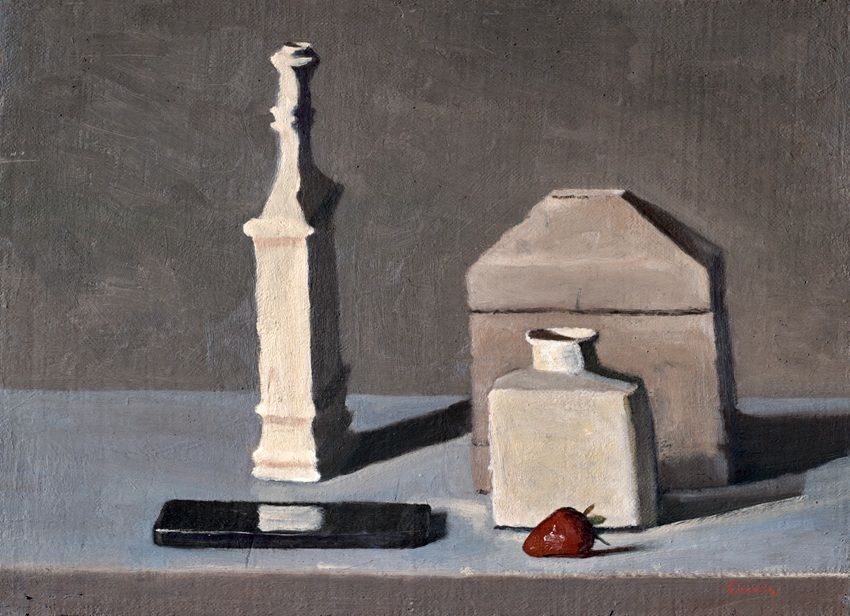
The life of Conrad’s still lives is both deep and rather playful and visually provocative. Alongside all the old funnels and vases, we also encounter an iPhone, which will soon join them in their obsolescence. And even that wretched instrument of distraction and addiction acquires a noble aura, notably through the reflection on its back thrown by the Persian vase behind it, epitomizing continuity between past and present.
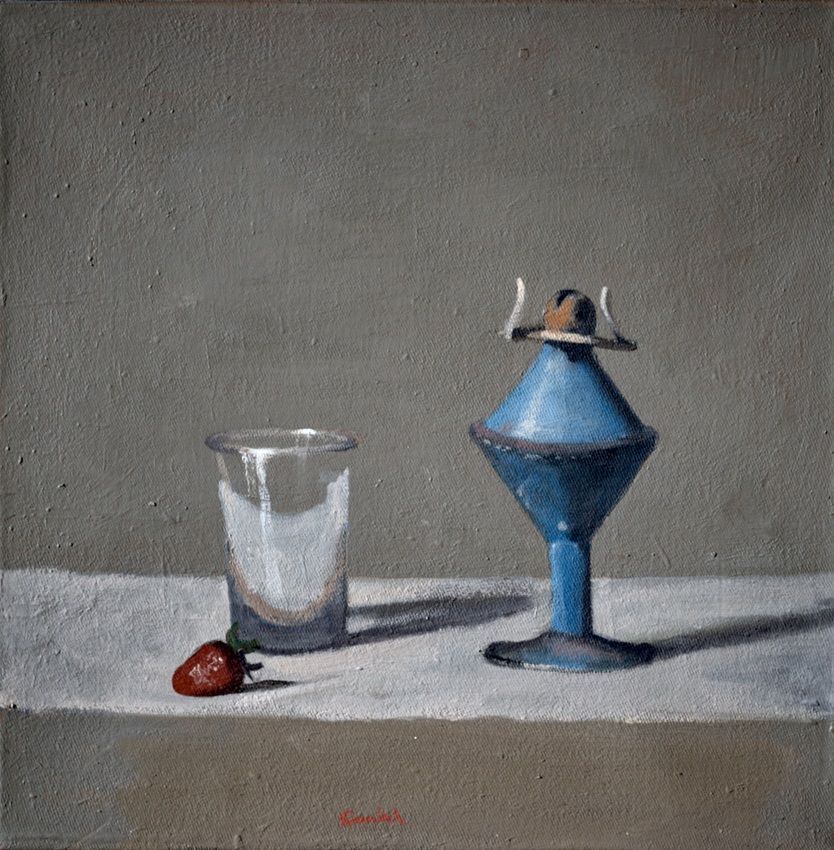
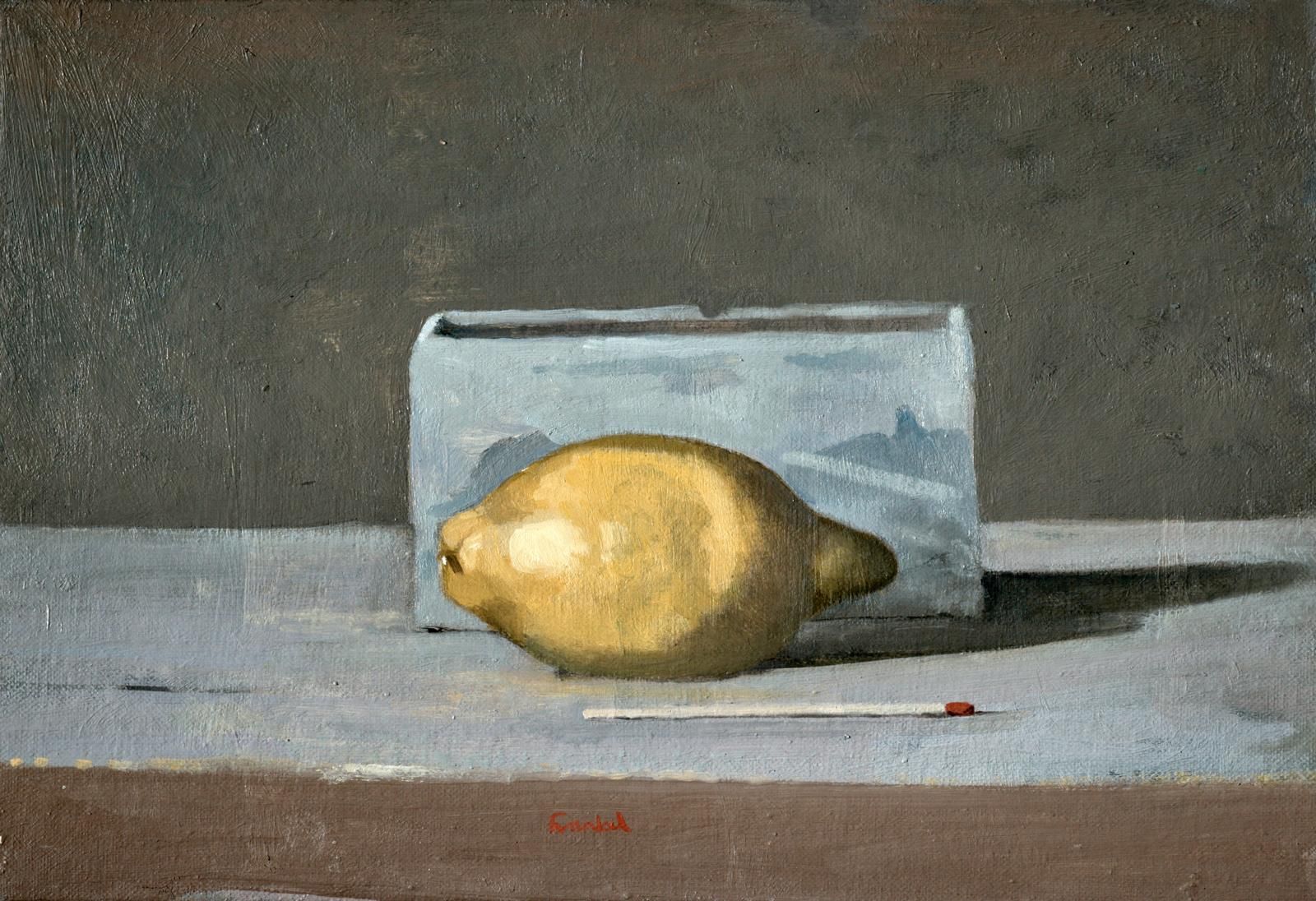
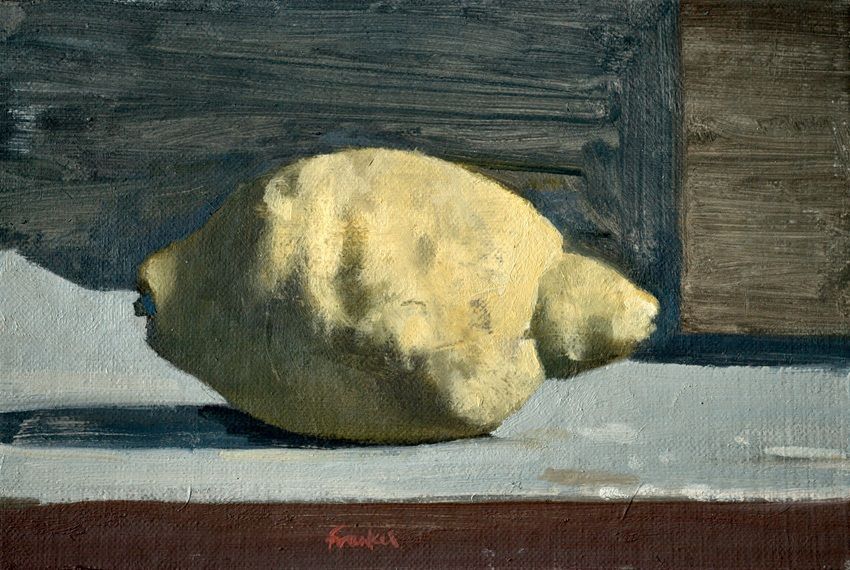
For me at least, the most arresting and pleasing jolt of life in these still lives comes from the delightful little strawberries found in five or six of the paintings. Amid the greys and the light blues, here is an unexpected burst of vivid colour. And it is not the only dash of vermilion we encounter here. Notice also the tips of the old-fashioned long matches, and, last but by no means least, the signatures – which light up the name “Frankel” (could there be any other?). It is a more controlled, more refined red than the one I remember in that teenage portrait of me. But it is still very much the red of life.
Max McGuinness is a Research Ireland Postdoctoral Fellow in French at Trinity College Dublin, having previously taught at University College Dublin, the University of Limerick, and Columbia University, where he received his PhD in French. His current research focuses on political themes in Proust and Franco-Irish literary imaginaries. He is the author of
Hustlers in the Ivory Tower: Press and Modernism from Mallarmé to Proust (Liverpool University Press, 2024) and co-editor, with Prof. Michael Cronin, of
The Irish Proust: Cultural Crossings from Beckett to McGahern (Bloomsbury Academic, 2025). He was also a theatre critic for
The Financial Times in New York and Dublin from 2016 to 2024 and currently reviews theatre for The Irish Times.
Coverage/Reviews
- What’s On: The auctions and exhibitions worth your time, Philip Carton, The Business Post, 9 May 2026
- Things to do, Michael Lanigan, Dublin InQuirer, 21 May 2026
- What’s On: The auctions and exhibitions worth your time, Philip Carton, The Business Post, 23 May 2026 (with photo of 'Roman lamp with
butterchurch and fruit', reproduced online) - Martin Shiels on his
Instagram account, 7 June 2026:
"Conrad Frankel is showing a series of still lifes at the Olivier Cornet Gallery, Dublin, appropriately called ‘Silent Light’. Studies in light and tone, these strength of these small paintings is in their simplicity and stillness.
Frankel works here within, presumably, self-chosen limitations. The still lifes are constructed from a small number of objects – an oil lamp, a funnel, a glass – arranged in simple compositions. All are lit by a cold light and painted in subdued shades of brown and grey. Spots of bright colour are introduced as contrast, again through recurring motifs – a matchstick, a strawberry or a lemon.
Resolutely figurative and in the tradition of Western still life, they are reminiscent of the works of Giorgio Morandi or Euan Uglow. However, the repetitive use of limited motifs and tones introduces an element of serialist minimalism to the work making them feel equally grounded in contemporary practices.
An unusual and effective element in these paintings is the use of very different frames throughout. At least some appear to have been recycled or repurposed. When seen hanging together like this, they emphasise the differences within the serial repetition..."