National Heritage Week 2026
     

Vetusavenir. A collage of words! by Colin Eaton


 Olivier Cornet Gallery,  Dublin (Ireland)

[If you have landed on this page from the link on the National Heritage Week website, please note that no booking is required]


The Olivier Cornet Gallery is a repeat participant of National Heritage Week. Check out our 2025 project with David Fox's Ridge of Capard painting, our 2024 project with Miriam McConnon's paintings of male suit jackets from The Refugee's Armour series, our 2023 project with Hugh Cummins's homage to André-Charles Boulle, our 2022 project with Annika Berglund's interest in locally-bred wool and her feltwork practice, our 2021 project with Eoin Mac Lochlainn's Harold’s Cross Heritage Apple Trees and our 2020 project with Yanny Petter's wonderful Calla Lily Blue for instance.


In view of the theme for National Heritage Week 2026, Heritage at Risk, we invited the artist Colin Eaton to reflect on a series of works which featured in Out of Lines, our 2025 show on art deco.

"The theme of this year's Heritage Week is Heritage at Risk. The word risk carries many meanings. As a noun it refers to the possibility of loss or injury. Risk is also a verb. One by their actions can incur risk of damage.
The only constant is change. Constant change. Constant changes. Risk is inherent. The challenge and indeed obligation is to identify and manage risk.
Think of the fragility of the works of the great masters. That doesn't remain constant. The risk of deterioration requires the maintenance of skilled conservators.
I think of the fragility of my own work. Part of my practice focusses on reusing discarded materials. Paper, cardboard, newspapers and ephemera. These materials are collected, collated and considered. Thoughtful introspection suggests new meanings. It is at once removed from risk of erasure and celebrated in a new context. But then new risks arise.
That word context plays an important part in the notion of heritage and risk. The object or idea may in and of itself be protected, conserved and restored as appropriate but its surroundings may be at risk, or pose a risk to that very object or idea.
An example being the Casino at Marino. Designed by William Chambers as a folly for James Caulfield, 1st Earl of Charlemont and built in the late 1700's. A magnificent example of Neo-Classical architecture and superbly maintained by the OPW. The risk to this wonderful jewel has been expertly managed.
But what of the risk to its surroundings. To its receiving environment. The Casino itself is one of the few remaining elements remaining of Charlemonts eighteenth-century demesne. However, the estate was sold to the Archdiocese of Dublin in the 19th century and later to the Christian Brothers. Nazareth House, a residential home for the elderly was built in the 1960's and significantly encroaches on the views of the Casino. Archbishop John McQuaid transferred land and construction of the new home began months before planning permission was granted. In later years a housing estate was constructed, again encroachment somewhat on the current approach to the Casino.
Thus illustrating that whilst the object itself might be carefully considered, a constant risk is posed by context. And not just physical context. Geopolitical forces pose risk to our heritage constantly. Constantly evolving legislation may or may not protect our heritage.
This is what makes Heritage Week such an important event. Of course Heritage Week is simply the culmination of months, indeed years of work by many. The important thing is that it brings to the fore, puts into conversation and celebrates our heritage. By doing so it highlights that richness and makes us all aware of what we are so lucky to enjoy and of what can be at risk.
In the context of the work which I created for the 'Out Of Line' group exhibition at the Olivier Cornet Gallery, a thematic exhibition celebrating the 100th anniversary of Art Deco I am delighted to revisit those three pieces.
The term Art Deco came into use after the 1925 Exposition internationale des arts décoratifs et industriels modernes in Paris. Having its origins in Cubism, the Vienna Secession, Fauvism and the Ballets Russes it represented luxury and glamour and signalled a new belief replacing the flourishes of Art Nouveau. But, in time it too was considered overly ornamental, particularly with its reliance on exotic and expensive materials. It too would be replaced, criticised for the creation of one-off pieces for the wealthy. Le Corbusier, for instance came to reject the 'superfluous' and stated that a house was, 'a machine to live in'.
Looking back I am reminded of the research for the exhibition and oddly of Agatha Christies Hercule Poirot! "If you are Hercule Poirot you must think of everything", he said. He also said, "no detail is too small". And of course his famous line, "the little grey cells". It is always fascinating (and a joy and honour to be invited) to take part in one of Oliviers thematic exhibitions. To begin with, he himself has put a great deal of thought into the theme and elements of what the exhibition might be. Then there is the far-reaching and varied research I am delighted to dive into.
I thought of the context that was Art Deco. What happened before. How some eventually came to reject it for its richness of material and perceived exclusivity.
An architectural training grounds my art practice in a certain rigour of form and thought. Seeing possibilities in discarded or otherwise overlooked materials and extracting them from their context. Having a quiet conversation with them. And then, allowing those pieces to perhaps converse. New contexts. New environments.
Working with discarded materials investigating new possibilities and meanings. Creating from those repurposed and discarded materials I investigate possibilities with paper and card where folds and cuts become incidents on a page, interweave, fragment and are peeled back and then reveal layer upon layer – a narrative.
Using mixed media and paper-cut collage techniques I seek to depict physical and psychological space, connections and disconnections, geometry and form and that sense of physicality and materiality imparts tactile and emotional qualities.
My works tend towards figurative abstraction inhabiting a space somewhere between abstraction and representation. Using the language of colour, texture and composition within the genre of papercut collage I set out to explore the potentially transformative space between the real, the manifest and the imagined. In the material sense the discarded becomes the celebrated.
More often than not I have a clear vision of what I want to create, but sometimes, within those constructs, frameworks and parameters I am pulled into an idea and the process allows, at times for the medium to guide, dictated to by the material available and also the offcuts and 'waste'. 
These materials sitting on the studio workbench, or floor, sometimes suggest in the manner of pareidolia (looking up at a cloud and imagining a form such as an animal), a new meaning. Tabula rasa does not exist.
What we do now is a palimpsest of what went before.
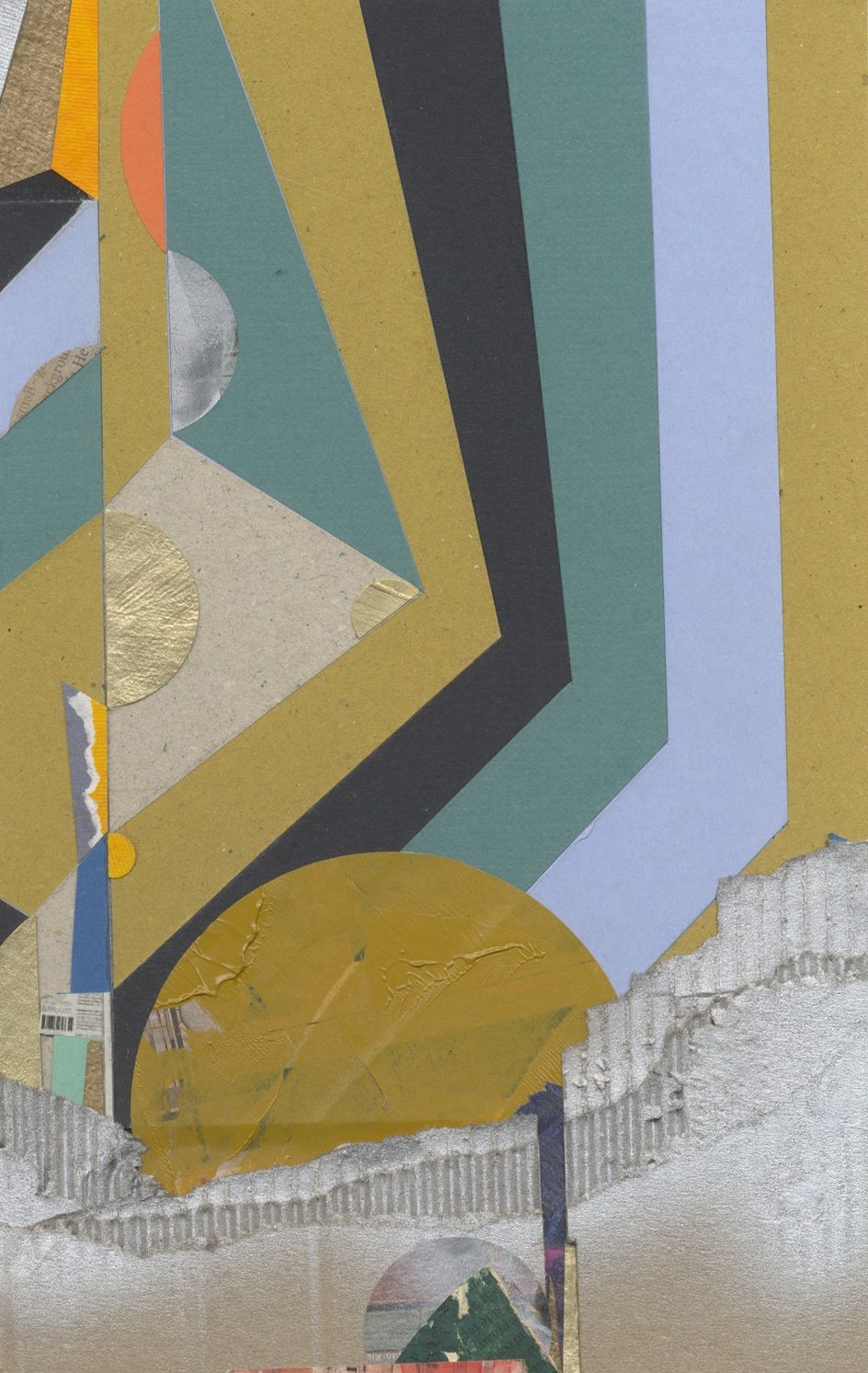
To honour Heritage Week I collaged some words! Vetusavenir! Vetus, from the Latin for Old and Avenir being French for the future. Together the old becomes the new. We respect it. We learn from it. We understand its contemporary relevance and find new ways of embracing it.

Rayon de Soleil, or ray of sunshine speaks of optimism. The sun rises. The old becomes the new. That parallels with my art practice wherein the old, as in discarded or overlooked materials become new and are given new life. Art Deco, shortened from the French, Arts Décoratifs first appeared in Paris in the 1910's. It embraced a belief in social and technological progress. In newness. It rejected what was seen as the overly elaborate styles that came before, although in many cases, particularly with its use of luxurious and exuberant materials Art Deco was just as elaborate. It did however, come to symbolise an optimism in the future and an embracing of new technologies.


Rayon de soleil is titled as a homage to the origins of art deco and depicts rays of the sun. A sign of optimism. Playing with the dominant graphic expression of the era of art deco the rays express themselves as angular and geometric forms. They emanate from a base composed of repurposed corrugated cardboard. Torn and cut. The old becomes new in the process.
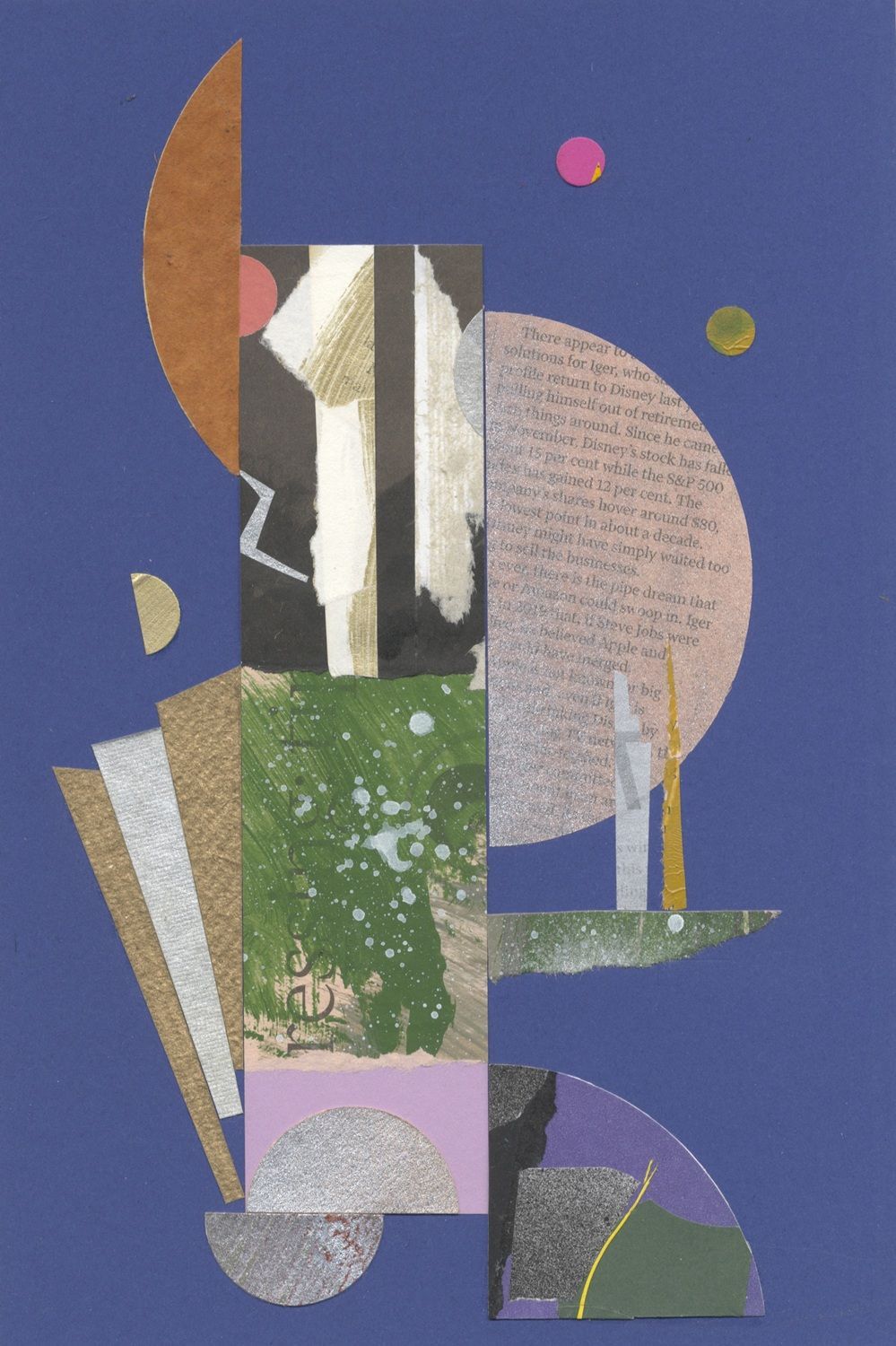
Cocktail Hour was a fun piece to research. Jazz, flappers, parties and of course – cocktails. The piece was inspired by the work of French jeweller and glass designer René Jules Lalique 


Best known for his creations in glass in the Art Deco style his techniques expressed contrast between clear and frosted glass and the use of patina and of 'pâte-de-verre', a technique of moulding ground glass. He worked on the design of luxury perfume bottles, creating for the likes of Guerlain and Rogeret et Gallet. For Citroën he created the 'Spirit of the Wind', or 'Victoire' mascot. Those clean lines, geometric forms and stylised elements such as chevrons and zig-zags spoke to me. His work, still, careful and considered stirred emotions and spoke of speed and a future. The essence of Art Deco.


Lalique's work on the Normandie Luxury Liner and the Côte d'Azur Pullman Express evoked the luxury and opulence of that movement. I thought of those soirées, the fashions, the 'new' jazz ... and cocktails.


In a Lalique glass perhaps.


This piece takes the old and makes it new. Part of my practice involves a fascination with the history and provenance of materials. Some of the elements then come from, 'the past'. Parts, pieces, offcuts from previous works set aside and kept in the expectation that they might present themselves in a new light. A new future. And so it was that some of those pieces from the past, at risk of oblivion were saved and given a new life in Cocktail Hour!


The placement of the geometric elements evokes movement, effervescence and joie de vivre. The central vertical element the stem of the cocktail glass. À la Tienne! Sláinte and Good Health!

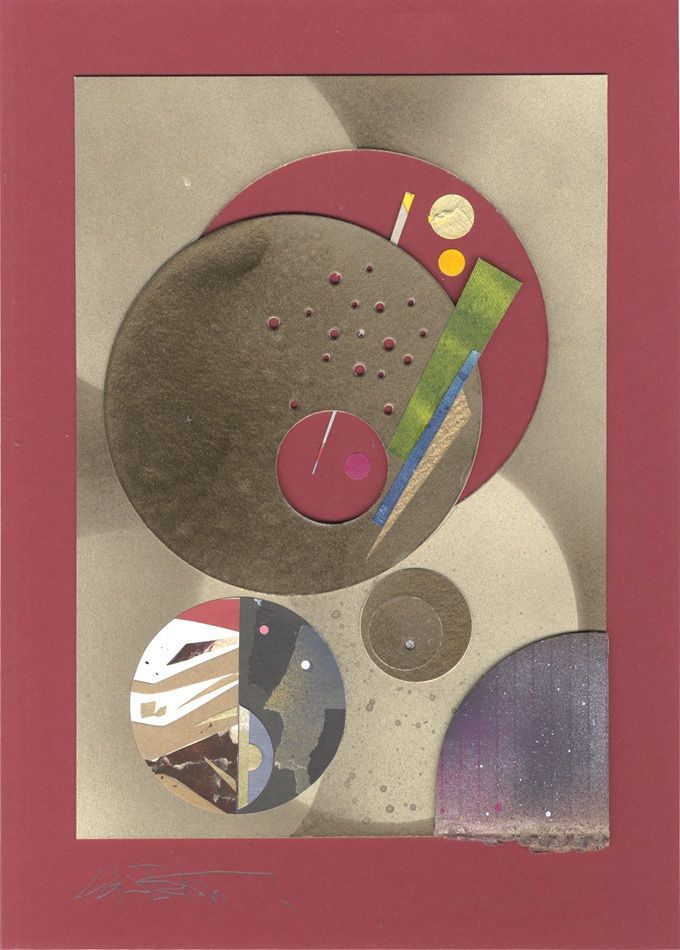
Cadence. Art Deco influenced music genres such as jazz with energetic rhythms and syncopation common. Melodic clarity was favoured, as in clear and memorable melodies. Orchestral arrangements with brass and woodwinds were popular.


A cadence is a term in Jazz to describe the end of a phrase which resolves tension created by another line of music. That spoke to me as my practice often involves the considered placement of disparate elements. Elements taken from my archives. A palimpsest of previous works overlaid with new elements and applications.


'Cadence' references the forms of the woodwinds. The clapper keys, valves, bells and garlands have been referenced by the use of a series of circular forms, their placement, some on the base, some floating brings to mind the sliding movement of the arm of the trombone changing in length to alter the pitch. 


The tones and shades of colour used pay homage to the instruments of jazz. The metallics. The brass. The lustre of the era of new hope. Of the new future, embraced through architecture, design, the motor car, the liner, fashion and of course, music.


The quadrant of corrugated card placed at the bottom of the work references music notation. It's departure in texture from the overall and with its torn edge celebrated speaks of an improvisation in the genre, an optimism in a future taken from the past."


Colin EATON


2026

National Heritage Week 2026 at the Olivier Cornet Gallery

During National Heritage Week 2026, Colin Eaton's text will feature in our exhibition space alongside his art deco series of works.


Do come along and also enjoy our current group show ‘God, Kinch, if you and I could only work together...


Opening hours during National Heritage Week are as follows:


Sat 15 August, 1pm - 5pm

Sun 16 August: Closed

Mon 17 August: Closed

Tues 18 August, 11am - 6pm

Wed 19 August, 11am - 6pm

Thur 20 August, 11am - 8pm

Fri 21 August, 11am - 6pm

Sat 22 August, 1pm - 5pm

Sun 23 August, 1pm - 5pm


No booking necessary for visits to the gallery. Free admission.


National Heritage in Dublin and No. 3 Great Denmark Street

Here is a good description of our recently-renovated building at 3 Great Denmark Street, as described by www.buildingsofireland.ie:

"Rising above the adjoining buildings, No. 3 Great Denmark Street conforms to the plot size and detailing of many houses developed by John Ensor (1715-87), the architect and developer who was involved in the development of much of eighteenth-century Dublin. The building retains a good doorcase, similar to others on the street. The appropriate timber sash windows contribute substantially to the architectural character of this Georgian house, and the retention of the original railings, gate and plinth, and steps to the entrance, all provide context, an excellent street edge, and contribute to the architectural and streetscape quality of this impressive street."


Do you know that no. 3 was once the town residence of the Lord Norbury, better known as The Hanging Judge?

https://en.wikipedia.org/wiki/Great_Denmark_Street