Annika Berglund
'Visible Sign Series: Drought, Storm, Flood'
A closer look by Seona Mc Dermott, volunteer at Olivier Cornet Gallery
At the end of February 2026, Seona Mc Dermott, volunteer at Olivier Cornet Gallery, wrote about Annika Berglund's Visible Sign Series:
Annika Berglund's Visible Sign Series: Drought, Storm, Flood are three distinct yet interconnected sculptures, each representing a specific climate phenomenon. Produced for the ‘2° C’ exhibition in 2017, Berglund created these 3 sculptures in different media such as clay, bronze, clear glass and porcelain. This exhibition was an artists’ response to climate change, at the VUE Contemporary Art Fair (RHA Dublin) and subsequently the Olivier Cornet Gallery. It was curated by Olivier Cornet
with the support of the Environmental Protection Agency (EPA) Ireland.
The bronze and clear glass sets can be found in the gallery’s storage area, which holds a fascinating archive of pieces from past exhibitions. The sculptures are priced between 550 and 850 Euro each, depending on the medium. The use of a variety of media really piqued my interest and even more when I delved into the subject matter – Berglund’s response to the ravages of climate change.
Berglund is a Swedish-born, Ireland-based artist whose career includes four solo exhibitions and many group exhibitions nationally and abroad. Initially working in ceramics, she added glass and bronze to her means of expression around 2010. She is currently working with felted wool. Her work is included in many collections including the National Museum of Ireland (Covid collection). She is represented by the Olivier Cornet Gallery in Ireland.
Artist’s techniques and aims
Berglund’s choice of media is highly intentional; clay, glass and bronze are all either elemental materials or derived from elemental materials, born of the earth and shaped by the same forces—water, heat, and pressure—that govern our planet’s weather systems.
Berglund states that her response to this theme was ‘based on the visible signs of climate change where weather patterns are growing increasingly intense, resulting in storms, flooding and drought. I really enjoyed making work for this exhibition in three different media and I was very happy with the visual aspect of the work. However, I did find it in some ways hypocritical to make work for an exhibition on global warming using three of the most energy hungry media you can choose. It was after this exhibition I started looking at less energy hungry means of expression and gradually started moving over to fibre based arts’.
My interpretation
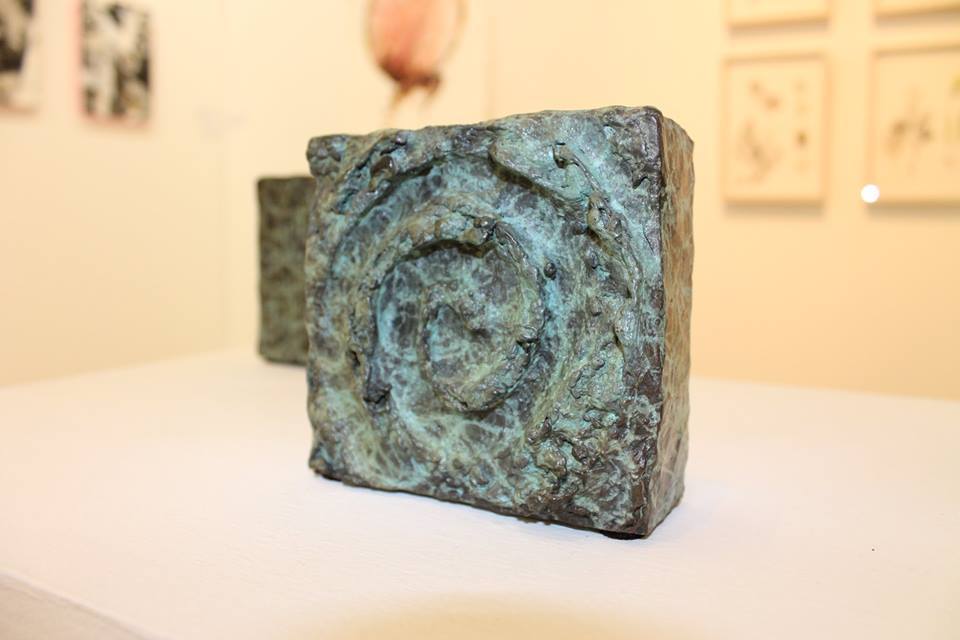
My initial feeling towards this artwork was that these square, uniformly sized pieces are small and contained, unlike the theme of climate chaos, yet are powerful in their representation of this theme. ‘Storm’ evokes an almost otherworldly cyclonic swirl. ‘Flood’ conjures up a rush/swell of flood water, while ‘Drought’ clearly depicts cracked, parched earth. Here, Berglund translates the abstract, often overwhelming data of global warming into tangible, emotive forms. There is a sense of fragility, as if the structure could shift or deteriorate over time. That fragility parallels ecological systems under stress. The bronze has developed a green patina, reminding us how natural forms can shift over time when exposed to different elements.
Conclusion
The meaning I came away with was that in the end, Visible Signs - Storm, Flood, Drought in its powerful simplicity invites careful attention to what is already happening around us, such as the recent windstorms and rainstorms here in Ireland, which seem stronger and more consequential than in previous years.
Berglund uses her art to bridge the gap between cognitive understanding and emotional realization, making an essential point: the signs are visible. The question is whether we are willing to see them. These pieces almost make us feel the weight of the water, the force of the storm and the heat of the cracked earth. They are a timely reminder that while the signs are now visible, the window for action is still open—if only just.
Seona Mc Dermott, 26 February 2026